SFT 2025-26-27 HERA Moonscape, Mars scape and Robotics Updated
Executive Summary: Modified
NASA HERA Moonscape, Mars scape and Robots Project - UPDATED Sandlot
Changes Please see
NOTE; Please replace Moon with MARS, or BOTH-Scape
NOTE: Consider Robots that will traverse the MARS Scape, Load the CUBESAT and Move CUBESAT and Place and Retrieve the CUBESAT,
Missions for Robots
( Do as many of the Basic Operations by the PDR and try the Innovative / Out-of-the-Box Missions for the CDR
Here is a **14-mission progression** designed so students can demonstrate increasingly sophisticated prototype capabilities. Missions 1–8 establish the essential HERA exploration system; Missions 9–14 push teams toward autonomous navigation, cooperative robotics, AI, communications challenges, resource utilization, and simulated Mars mission operations.
## Basic Operations — Missions 1–8
**Mission 1 — First Drive on Mars**
The robot must leave its designated HERA base location, travel across the Mars-Scape to three marked checkpoints, and safely return to its starting position. Students must demonstrate reliable forward/reverse movement, turning, stopping, and remote control without striking the walls, rocks, craters, or other equipment.
**Mission 2 — Drive by Camera Only**
The robot must navigate the course while its operator cannot directly see the Mars-Scape and must rely entirely on the robot's onboard camera. The operator must locate three designated landmarks and transmit images of each back to Mission Control, demonstrating the project's required video and remote-operations capabilities. ([NASA Hunch][1])
**Mission 3 — Crater and Rock Obstacle Course**
The robot must travel through increasingly difficult terrain containing rocks, slopes, crater edges, loose simulated regolith, and narrow passages. Students must demonstrate that the robot can maintain traction, stability, maneuverability, and communications while successfully reaching a designated science location.
**Mission 4 — Day and Night Exploration**
Students repeat an exploration mission under both illuminated and simulated nighttime conditions. The robot must use onboard lights, infrared cameras, or another sensing method to locate designated objects and safely navigate back to base, directly supporting NASA HERA's requirement for day/night operational verification. ([NASA Hunch][2])
**Mission 5 — Pick Up the CubeSat**
Place a simulated **10 cm³ CubeSat/ArduSat payload weighing up to one pound** at a designated location and require the robot to locate, grasp, lift, and transport it. The robot must deliver the payload to a marked deployment zone without dropping or damaging it, demonstrating the project's payload transportation and manipulation requirements. ([NASA Hunch][1])
**Mission 6 — Precision CubeSat Deployment**
The robot must retrieve the CubeSat, navigate through an obstacle course, and precisely place it inside a designated deployment target rather than simply dropping it. Students must demonstrate controlled manipulation using a robotic arm, gripper, lift, or another mechanism and then verify successful placement using the onboard camera.
**Mission 7 — Dig, Mine and Return**
The robot must travel to a designated mining zone, collect a measured quantity of simulated Martian regolith, place it into a sieve or student-designed mining apparatus, and collect the processed material. It must then transport the sample back to the HERA base without losing more than a student-defined allowable percentage of its payload, reflecting the project's proposed regolith mining mission. ([NASA Hunch][1])
**Mission 8 — Complete HERA Exploration Mission**
Starting at the HERA base, the robot must navigate the Mars-Scape, inspect designated landmarks, collect imagery, retrieve and deploy a CubeSat, collect a regolith sample, and return to base. Mission Control must receive live or recorded video, robot status, mission events, and a final mission log, integrating the project's navigation, communications, payload, mining, monitoring, and data-logging requirements. ([NASA Hunch][1])
## Innovative / Out-of-the-Box Missions — Missions 9–14
**Mission 9 — Lost Communications!**
While the robot is traveling across the Mars-Scape, Mission Control deliberately interrupts its Bluetooth, Wi-Fi, IR, or primary communications link for a predetermined period. Instead of stopping helplessly, the robot must safely halt, retrace its route, continue toward a predefined safe point, switch to a backup communication method, or execute another student-designed **loss-of-communications protocol** before reconnecting with HERA.
**Mission 10 — AI Mars Navigator**
Students give the robot a destination but no predetermined route; using cameras, ultrasonic sensors, LiDAR, computer vision, or other sensors, the robot must identify rocks, craters, slopes, and blocked paths and autonomously determine a safe route. If an unexpected obstacle is introduced during the mission, the system must recognize the change and calculate a new path without operator steering.
**Mission 11 — Search and Rescue on Mars**
A simulated astronaut has lost a critical equipment package somewhere in the Mars-Scape, and Mission Control knows only its approximate location. The robot must autonomously search the terrain, use computer vision, RFID, thermal/IR sensing, or another technology to identify the correct object among several decoys, retrieve it, and return it to the HERA base.
**Mission 12 — Four Robots, One Mission**
Deploy multiple specialized robots—a **Scout, Transporter, Manipulator, and Mining Robot**—that must cooperate to accomplish a mission no individual robot can complete alone. The Scout maps a safe route, the Transporter carries the CubeSat, the Manipulator deploys it, and the Mining Robot collects regolith, while a central Mission Control system tracks each robot and reallocates tasks if one becomes unavailable; the HUNCH concept specifically envisions four specialized robotic units. ([NASA Hunch][1])
**Mission 13 — Build a Mars Resource Station**
Instead of simply collecting regolith, the robots must identify promising collection areas, gather material, transport it to a processing station, separate material using the sieve/mining apparatus, measure the processed quantity, and deposit it into labeled storage containers. Students could add AI terrain classification, automated weighing, mineral-color identification, or a digital inventory system so the mission becomes a small-scale demonstration of **In-Situ Resource Utilization (ISRU)**.
**Mission 14 — 45-Day Mars Mission: HERA Grand Challenge**
Simulate an accelerated version of a **45-day HERA isolation mission** in which the robotic fleet receives changing exploration objectives, CubeSat deployments, science targets, mining assignments, day/night operations, blocked routes, communication failures, equipment problems, and unexpected discoveries. With minimal direct intervention, the system must prioritize missions, coordinate robots, conserve power, recover from failures, return science samples and payloads, and generate a final **HERA Mars Exploration Mission Report** containing robot telemetry, maps, imagery, mission results, failures, recoveries, and lessons learned. ([NASA Hunch][1])
Please See Robotic Details: Item 3
Requested by NASA HERA
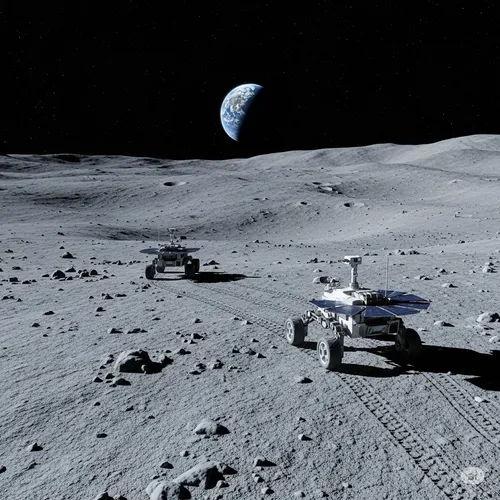
The NASA HERA Moonscape and Robots project is designed to elevate the realism and educational value of the Human Exploration Research Analog (HERA) program by integrating a remotely operated robotic lunar exploration component. The initiative centers on the development of a highly detailed, portable 8ft × 8ft lunar landscape—modeled after the Moon’s south pole crater region—or a virtual reality (VR) equivalent, alongside a suite of four specialized robots. These robots will be remotely operated by HERA participants (HERAnauts) during their 45-day isolation missions, simulating authentic lunar exploration tasks and mission protocols.
Hold Off the Moon Scape and Mars Scape things are influx, except if you are using this for testing. The moonscape itself will feature realistic crater-within-crater topography, 3D-printed rocks, and surface materials that closely mimic actual lunar regolith. Visual barriers and integrated lighting systems will ensure that the environment remains immersive, blocking any view of the outside world and supporting both day and night operational scenarios. The landscape is designed for portability, folding in 8ft × 8ft Moonscape into sections for easy assembly and storage in a 4 ft wide cabinet.
The Robotic System will consist of four IR, WIFI or Bluetooth Remote controlled robotics units, each with distinct roles: transportation, manipulation, and support. These robots must be capable of carrying and transferring 10cm³ cubes (representing ArduSat/Cubesat payloads) weighing up to one pound, with at least one robot equipped with a lifting arm for precision placement. All robots will feature onboard cameras (standard and infrared options) and will be operated within a 50-meter range of the HERA module, through thin metal walls. See You tube Videos and Links.
This project is structured in phases: initial planning and requirements gathering, student-led prototype development (including scaled models and VR options), and final construction and testing. The integration of these moonscape and robotic systems will provide HERA participants with engaging, hands-on lunar exploration activities, enhancing psychological fidelity and mission immersion while supporting STEM education objectives through the NASA HUNCH program.