SFT 2026-27 - AI Plant Growth for Space
NASA Reference Name: ERT-P1-2026-AI-Plant - Lunar - Autonomous - Robot
Executive Summary
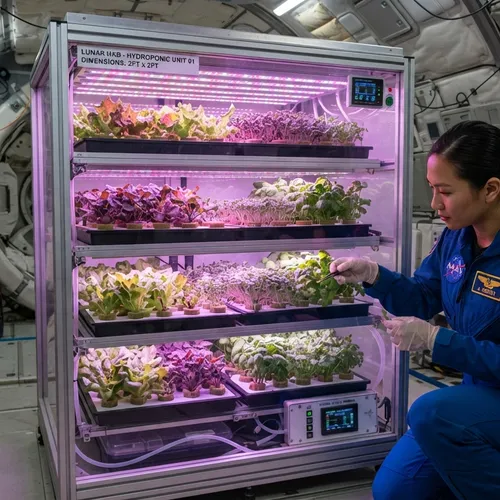
Build an AI-assisted system that monitors enclosed-habitat plants in real time, automatically adjusts conditions to reduce stress, and actively promotes the growth of each individual plant — factoring in artificial light and reduced (1/6 g) gravity. Deliverable: an automated 'robot greenhouse' concept/prototype that diagnoses issues and adjusts care (water, light height, climate) per plant, a defined list of monitored stressors, and a proposed pollination-automation approach.
Requested By
NASA — NASA Staff, Exploration Research and Technology, Kennedy Space Center
Problem Statement
Astronauts must grow plants inside confined Moon, Mars, and ISS habitats where resources — especially water — are scarce and crew time is extremely limited. Individually potted plants face multiple stresses (water, air, temperature, airflow, soil pH, radiation), and tasks such as watering and pollination are done by hand. A system is needed that uses AI to detect plant stress in real time, automatically reduce it, and promote healthy growth per plant while conserving resources.
Requirements Overview
Real-time, 24/7 monitoring with automated feedback control
AI stress detection: water, air, temperature, airflow, soil pH (and radiation)
Individualized watering — no over- or under-watering
Automated growth promotion (e.g., adjustable LED light height)
Resource-efficient: minimal water use and crew time
Automated pollination method (e.g., air-blast)
Contamination control / growth-medium sterilization
Major Constraints
Water is the most precious, limited resource — essentially zero waste allowed
Astronaut time is extremely limited — no hours for manual care or pollination
Confined, enclosed habitat — individual potted plants, not large crops
Reduced gravity — microgravity (ISS) and 1/6 g (Moon) affect growth and pollination
No bugs (no live pollinators)
Key Challenges
Pollination in enclosed / low-gravity habitats (hand brush vs. air-blast)
Contamination control: stray seeds/weeds; growth-medium sterilization
Allergen containment (allergens stay aboard the ISS; Moon filtering unknown)
Reduced-gravity effects on roots, growth, and pollination
Radiation, extreme temperatures, regolith toxicity
Balancing factors that promote vs. retard growth
Cards
1 — Other Points / Comments
Must align with NASA HUNCH / Moon to Mars to be eligible
Compare ISS systems — Veggie (open) vs. APH (sealed, airflow-controlled)
Context: an expanding lunar build-out — habitats, comms, rover rentals, roads (regolith)
Strong spinoff value for Earth (water-efficient vertical farming)
2 — Examples of Excellence
Benchmark: the NASA Advanced Plant Habitat (APH) — the largest fully automated, fully enclosed plant habitat flown on the ISS
Closed-loop control of water, atmosphere, moisture, and temperature
Sensors and cameras in constant contact with the Kennedy ground team
Supports experiments lasting up to 180 days
Sets the standard for automated, enclosed, hands-off plant care
3 — Examples of Innovation
AI-driven, per-plant individualized care (water and light)
Grow lights that automatically raise as plants grow taller
Robotic / air-blast pollination to save scarce crew time
Integration with bioregenerative life support (MELiSSA, BIO-Plex)
Artemis III LEAF — the first lunar-surface plant biology experiment
Automatic stress diagnosis paired with automatic correction
Suggestions for High School Students
Scope can be scaled to the team's level
Start with water optimization only, then add stressors (air, temperature, airflow, soil pH)
Add growth-promotion controls (e.g., automated lighting height) as a next phase
Treat pollination automation (air-blast) as a stretch goal
Choose the target environment (ISS vs. Moon) to match the difficulty you want
Please review more info below:
Requirements Spec
Other Points / Comments
Examples of Excellence
Samples of Innovation
User Stories