SFT 2026-27 LLASO Project 1 - Lunar Logistics Supply Chain (VR Simulation, Game or Math Model)
LLASO Project 1 - Lunar Logistics Supply Chain (VR Simulation, Game or Math Model)
NASA Reference Name: LLASO-P1-VR-2026
Executive Summary
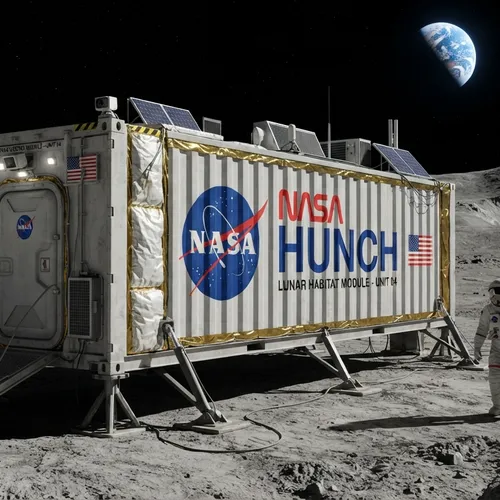
Build a multi-step simulation (VR, game, or math model) that shows how a lunar cargo container is packed and loaded on Earth, then unpacked in lunar gravity after arrival. This is the conceptual backbone of the LLASO initiative — its environment and dimensions feed every other project. Objective: cover (1) Earth-side optimized packing/loading and (2) lunar arrival and pressurized unloading. Deliverable: a working simulation with at least an Earth phase and a lunar phase, demonstrating packing optimization and 1/6 g unloading. The overarching aim is to optimize packing capacity and the efficiency of unloading on the Moon.
Requested By
NASA HUNCH / Kennedy Space Center
Problem Statement
Optimize the packing solution for a cargo container up to 40 ft long (or a cylinder of equivalent length, 3 meters in diameter). The emphasis is an optimized way to pack and unpack a lunar cargo module on Earth, move it from the logistics hall to the lunar surface, and then unload it with minimum human involvement on the Moon — potentially using robot(s). Background: with the change of focus and the postponement of the GATEWAY station, the lunar logistics focus (DSLM) has shifted to Logistics and Optimization.
- Propose the internal Structure to place all the supplies
- Also see General Requirements at ROBOTICS at SFT 2026-27 Additional Resource HUB for Software and Hardware Engineering plus Robotics Click Here!!
Requirements Overview
Simulate a cylindrical or box cargo container module (~3 m dia., ~40 ft long)
Model CTBs, lockers, and canister cargo types, including unusual shapes
Track the location of CTBs, lockers, canisters, packing boxes, etc.
Include 1/6 lunar gravity physics on the Moon, regular gravity on earth
Support both rack & stacks plus other internal container infrastructure
Include loading and unloading sequences
Be usable with no prior VR experience, with a display
Major Constraints
Lunar gravity is 1/6 of Earth's — mass handling behaves differently
Regolith contamination must be excluded from all pressurized spaces
No specific commercial launch vehicle can be assumed — the design must be generic
The cargo module interior must stay accessible by robot or human
Key Operational Goals
Players must load and retrieve cargo items in the shortest possible time, while accurately tracking the location, size, and weight of every item. The key performance metrics are:
Measure and Record
Time — speed of placement and retrieval
Quantity — how completely the container is filled
Weight — total load and distribution ( Set
Tracking — knowing the exact location of each item type
Cargo Types
Each challenge should incorporate a mix of the following items:
Cargo Transfer Bags (CTBs): 1U, 2U, 3U, 4U, 5U, or 6U
Metal Lockers: 1U, 2U, 3U, 4U, 5U, or 6U (e.g. https://nasahunch.com/catalog/single-stowage-lockers-c4u694ynuv68l7zchdnnqxle and https://nasahunch.com/catalog/double-stowage-lockers-cqdungh47ekjnsmaejw5p7ab )
Unusual/irregular items: PODS and cylinders (e.g., 4 ft high × 2 ft wide)
Mission Loading Strategy
All challenges must follow a realistic mission-based loading logic:
The scenario is based on a 14-day mission.
LIFO (Last-In, First-Out) principle: Items needed on Day 1 of the mission are loaded last; items needed on Day 14 are loaded first.
Players must plan their initial loading strategy around this reverse-chronological supply schedule.
Key Challenges
Balancing load distribution in reduced gravity
Preventing collisions when cargo is floating during the transit phase
Designing an interface that works for both robot and human operators
Getting the most packaging into a container — safely, trackable, location-based — in the shortest time, then unloading it in a receiving building on the Moon
Please review more info below at : Lots more to Read
Missions for Robots
( Do as many of the Basic Operations by the PDR and try the Innovative / Out-of-the-Box Missions for the CDR
Yes. I would make this version of the LLASO Project 1 missions more explicitly about **inventory planning over time**—not simply moving boxes. The student simulation should have to decide **what is loaded, where it is stored, when it is needed, who/what retrieves it, what replaces it, and where waste goes**.
That is particularly appropriate for a lunar South Pole scenario because NASA describes the region as having rugged terrain, abrasive dust, extreme temperatures, moving long shadows, and permanently shadowed regions; those conditions make location, travel time, power, and storage decisions operationally important. ([NASA][1])
Absolutely. I would restructure the LLASO Project 1 challenge around the **complete lifecycle of a 14-day lunar supply mission**: first optimize and load the cargo container on Earth in reverse-use order; then unload and distribute it on the Moon with minimum astronaut labor; finally introduce increasingly difficult disruptions and autonomous logistics challenges.
This is well suited to the NASA HUNCH Software/Technology program because teams can demonstrate the missions through a **VR simulation, game, mathematical/optimization model, database, AI system, or combinations of these**, while still producing a working, testable product. ([nasahunch.com][1])
# LLASO Project 1 — 18-Mission Lunar Logistics Challenge
## Phase I — Earth: Plan, Optimize & Load
### Missions 1–6 — Basic Operations
**Mission 1 — Build the 14-Day Lunar Manifest**
Students receive a 14-day lunar mission schedule and a master inventory containing food, water, clothing, medical supplies, science equipment, tools, spare parts, fabrication materials, batteries, and emergency supplies. Their system must determine **what is required on each mission day**, its quantity, mass, volume, storage requirements, and whether the item will ultimately be handled by an astronaut, robot, or another mechanism.
**Mission 2 — Load Day 14 First, Day 1 Last**
Students must create the initial cargo-loading sequence using the principle that supplies needed on **Day 14 are loaded first and Day 1 supplies are loaded last**, making the earliest-needed cargo most accessible when the container reaches the Moon. The prototype must visually or mathematically demonstrate the loading order and identify conflicts where size, mass, fragility, refrigeration, or safety prevents a perfect reverse-day sequence.
**Mission 3 — Fit Everything in the Container**
The available cargo exceeds the container's ideal volume, forcing students to optimize placement in three dimensions while respecting mass, center-of-gravity, stacking, fragility, and accessibility constraints. The system must produce a cargo map identifying the exact **container, rack, shelf, zone, row, or coordinate** where every item is stored.
**Mission 4 — Perishable, Fragile & Hazardous Cargo**
Add refrigerated/perishable food, medical materials, fragile science equipment, batteries, liquids, and other cargo requiring special handling. Students must determine where these items should be placed while still preserving the Day-14-to-Day-1 loading strategy and clearly flag items that require special environmental control or astronaut authorization.
**Mission 5 — Load by Mission, Not Just by Day**
Each day now contains several activities—crew meals, science experiments, habitat maintenance, fabrication, EVA preparation, medical operations, and robot maintenance—so simply grouping cargo by date is no longer sufficient. Students must create **mission kits** that place commonly used supplies together so astronauts and robots do not repeatedly search through unrelated cargo.
**Mission 6 — Earth Departure Verification**
Before launch, the system must conduct a final digital inspection comparing the physical or simulated cargo against the 14-day manifest and verify quantity, location, mass, destination, priority, and expected retrieval day. Students must demonstrate that the software can detect a deliberately misplaced, missing, duplicated, overweight, or incorrectly sequenced item **before the cargo container leaves Earth**.
---
# Phase II — Moon: Unload, Retrieve & Deliver
### Missions 7–12 — Lunar Operations
**Mission 7 — Day 1: Open the Container**
The cargo container arrives at the lunar South Pole, and the logistics system must identify which Day 1 supplies should be removed first and where they need to go. The system must assign each unloading operation to the appropriate **external robot, internal robot, mechanical handling device, or astronaut**, with the explicit goal of minimizing astronaut lifting, carrying, searching, and repetitive handling.
**Mission 8 — Robot-to-Robot Cargo Handoff**
External cargo robots move designated containers from the landing area to the supply facility, where cargo must be transferred to an internal handling system or robot. Students must demonstrate positive cargo identification at every handoff so the digital manifest always knows **what the item is, where it is, where it is going, and which person or machine currently controls it**.
**Mission 9 — Retrieve Today's Mission Kits**
The crew's daily schedule changes from simply "Day 3 supplies" to specific activities such as breakfast, an EVA, a science experiment, equipment maintenance, and fabrication. The logistics system must retrieve and stage the correct mission kits at the correct locations and times, using robots wherever practical so astronauts spend their time performing mission work rather than searching for supplies.
**Mission 10 — Astronaut Effort Challenge**
Students repeat an unloading day while measuring **astronaut touches, astronaut carrying distance, astronaut handling time, robot travel distance, and total retrieval time**. They must modify their logistics strategy to reduce astronaut involvement while still requiring a person for tasks involving judgment, authorization, delicate handling, safety decisions, or activities that cannot reasonably be automated.
**Mission 11 — Consume, Replace & Remove**
As supplies are consumed, replacement filters installed, fabrication materials used, equipment unpacked, and batteries exchanged, the logistics system must automatically update inventory and create appropriate destinations for packaging, used components, fabrication scraps, recyclables, and garbage. Robots should remove routine waste and reposition replacement materials whenever possible rather than assigning astronauts to act as cargo handlers.
**Mission 12 — Complete 14-Day Lunar Mission**
Run the complete Day 1 through Day 14 scenario, progressively emptying the cargo container while simultaneously creating waste, empty packaging, failed components, reusable containers, and return cargo. At mission completion, students must demonstrate **100% inventory accountability**—every original item must be identified as consumed, installed, stored, transferred, fabricated into something else, recycled, discarded, or prepared for return.
---
# Phase III — Innovation & Autonomous Logistics
### Missions 13–18 — Out-of-the-Box Challenges
**Mission 13 — The Astronaut Never Searches for Anything**
The system receives the crew's next-day schedule and automatically predicts which food, tools, experiment packages, replacement parts, clothing, batteries, and other supplies will be needed. Robots retrieve and stage those materials **before the astronaut asks for them**, with the objective of reducing astronaut cargo-search time as close to zero as practical.
**Mission 14 — The Cargo Container Reorganizes Itself**
As Days 1–7 supplies disappear, the original loading arrangement becomes increasingly inefficient and creates empty spaces throughout the container. The AI must recognize these changes and direct robots or automated storage mechanisms to reorganize the remaining Days 8–14 cargo so frequently needed, emergency, heavy, fragile, and upcoming mission supplies remain optimally positioned.
**Mission 15 — Something We Need Is Missing**
On Day 9, astronauts discover that a mission-critical replacement component was never loaded, but raw materials, spare components, and fabrication equipment are available on the Moon. The system must determine whether to **substitute, repair, cannibalize, fabricate, postpone, or request resupply**, then assign each approved action to the appropriate astronaut, robot, fabrication system, or maintenance facility.
**Mission 16 — Garbage Becomes a Resource**
By Day 11, packaging, empty containers, worn components, fabrication scraps, and other waste occupy valuable storage volume, so the logistics AI must determine what should be **reused, repaired, recycled, repurposed, compacted, stored, returned, or discarded**. Students receive additional credit if their system discovers useful second lives for cargo packaging—for example, converting containers into storage bins, shielding, structural elements, or fabrication feedstock.
**Mission 17 — Lunar Logistics Emergency**
A robot fails, a normal transportation route becomes unavailable, and an urgent medical or life-support component is required while astronauts are conducting another mission. The logistics system must autonomously reprioritize operations, locate the required item, identify an alternate robot/mechanism or human intervention when necessary, establish a new route and handoff sequence, and deliver the emergency cargo while minimizing disruption to the rest of the base.
**Mission 18 — Autonomous Lunar Supply Chain Grand Challenge**
Run the complete 14-day mission from **Earth loading through lunar unloading, daily retrieval, consumption, replacement, fabrication, recycling, garbage management, emergencies, and return preparation**, while introducing unexpected schedule changes, robot failures, misplaced cargo, damaged supplies, and changing crew priorities. With minimal human intervention, the student system must continuously determine **WHAT is needed, WHEN it is needed, WHERE it is located, WHERE it must go, and WHO or WHAT should perform the task**, then produce a final mission report documenting astronaut labor saved, robot utilization, retrieval times, inventory accuracy, waste generated, failures, recoveries, and overall logistics performance.
## A key design rule for all 18 missions
I would make **“Correct Actor Assignment”** a required metric throughout the challenge. NASA HUNCH emphasizes working software products spanning robotics, AI/ML, VR/AR, databases, real-time systems, game design, quality assurance, and user testing, so Project 1 can serve as the **decision-making/logistics layer** coordinating the other LLASO systems rather than merely becoming another robot-driving exercise. ([nasahunch.com][1])
For every cargo action, the students' system should therefore record: **Item → Day Needed → Mission → Current Location → Destination → Priority → Handling Requirements → Assigned Actor → Retrieval Time → Status.**
The **Assigned Actor** should distinguish at minimum between **Astronaut, External Cargo Robot, Internal Cargo Robot, Mechanical/Automated Handling System, Fabrication System, Maintenance/Repair System, and Mission Control**. The central objective is not to eliminate astronauts from logistics entirely; it is to reserve their limited time for activities where human judgment, dexterity, authorization, science, or safety oversight adds value, while automating routine cargo handling wherever the prototype can demonstrate that it is practical and safe. This fits HUNCH's broader emphasis on open-ended, team-based engineering solutions that culminate in functioning student products. ([nasahunch.com][1])
[NASA HUNCH Software & Technology Hardware Engineering plus Robotics](https://nasahunch.com/programs/software?utm_source=chatgpt.com)
[1]: https://nasahunch.com/programs/software?utm_source=chatgpt.com "Software and Technology Hardware Engineering plus Robotics"