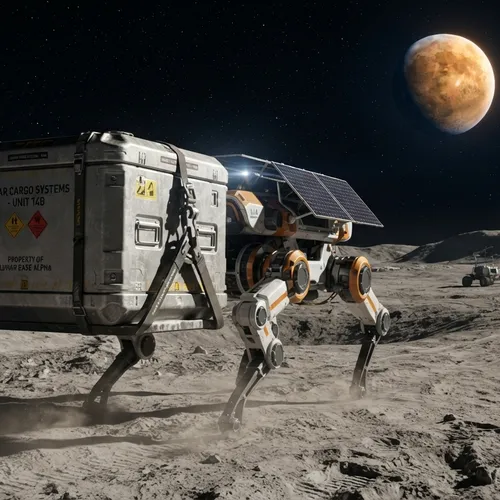
SFT 2026-27 LLASO Project 2 - External Cargo Transport Robot (Rocket to Supply Building)

LLASO Project 2 - External Cargo Transport Robot (Rocket to Supply Building)

NASA Reference Name: LLASO-P2-XPORT-2026


Executive Summary

Design and prototype a robot that moves a landed cargo module from the landing pad to the habitat's supply building and docks it to a pressurized port — in low gravity, over unprepared regolith, and without requiring an astronaut to go outside. Deliverable: a concept prototype robot, or a high-fidelity CAD / simulation, with a demonstrated navigation and docking sequence.


Requested By

NASA HUNCH / Kennedy Space Center; NASA Robotics / Marshall Habitation


Problem Statement

Once a ~40 ft cargo module lands on the lunar surface, it must be moved from the landing pad (kept away from the habitat to avoid plume contamination) to the supply building and docked to a pressurized port — without human EVA involvement wherever possible.


Requirements Overview

Handle a module mass equivalent in 1/6 g (may be scaled for an Earth demo)

Navigate unprepared lunar regolith terrain

Include a dust-exclusion coupling at the habitat dock (~1-2 m opening)

Operate autonomously, with human override capability

Use a solar + battery power architecture

Require no human EVA for nominal transport operation


Major Constraints

Regolith is abrasive and clings electrostatically — all seals and joints must account for it

The plume blast zone means the module lands far from the habitat, so the robot must traverse a significant distance

1/6 g means lighter loads but also lower traction for wheeled/tracked systems

The docking interface must seal to the habitat pressure boundary before the module hatch opens


Key Challenges

Designing a gripper or cradle that handles an irregular cylindrical load

Maintaining dust exclusion at the docking collar

Budgeting power for a long-distance traverse with a heavy load

Avoiding tipping instability when carrying an elevated load in low gravity


Please review more info below:

Requirements Spec

Other Points / Comments

Examples of Excellence

Samples of Innovation

User Stories


Other Points / Comments

Coordinate with the Project 3 team on module orientation — the transport robot must deliver the module in the correct entry orientation

Teams are encouraged to look at ISS and submarine hatch designs for docking inspiration

Swamp Works at KSC is a potential expert contact for lunar rover design


Examples of Excellence

The robot performs a full autonomous route from a 'landing pad' marker to a 'habitat' dock with no human input

The dust-exclusion seal is designed and tested with a simulated regolith substitute

A power-consumption model is provided, with solar recharge-time estimates


Examples of Innovation

A modular cradle design that works for both cylindrical and rectangular modules

The robot self-parks in the P5 Repair Garage when not on a transport mission

An onboard camera feed is streamed to a habitat display so the crew can monitor the approach without EVA


Suggestions for High School Students

An Earth demo may scale the module down to fit in a 24” Cube

Navigation can use a pre-mapped path rather than fully autonomous SLAM

Docking can be demonstrated with a simplified mock interface

Wheeled, tracked, or legged robot chassis are all acceptable — choose based on your team's build skills

Start with a scaled Earth rolling demo, then add the docking sequence