SFT 2026-27 - LLASO Project 3 - Internal Cargo Unloading Robot (Inside the Module)
LLASO Project 3 - Internal Cargo Unloading Robot (Inside the Module)
NASA Reference Name: LLASO-P3-UNLOAD-2026
Executive Summary
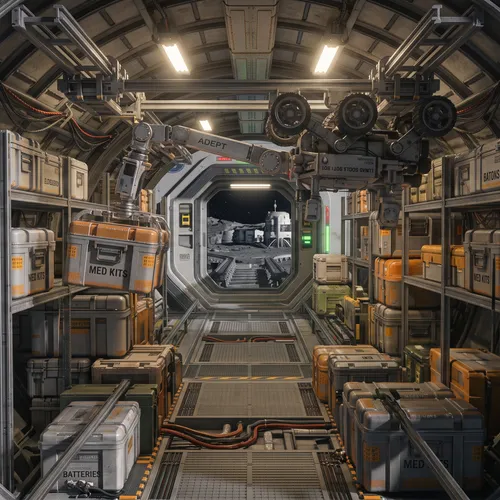
Design and prototype a robot that works inside a pressurized, cylindrical cargo module to retrieve, classify, and hand off cargo items — adapting to a curved interior and low-gravity handling while working safely alongside human crew. Deliverable: a working prototype or simulation demonstrating navigation of a cylindrical interior and item handoff in 1/6 g.
Requested By
NASA HUNCH / Kennedy Space Center; NASA Habitation / Marshall
Problem Statement
Once a cargo module is docked to the habitat, someone or something must go inside and systematically remove the cargo items, in a pressurized shirt-sleeve environment. (Assume that once the module is docked, regolith is considered controlled.)
Requirements Overview
Operate inside a cylindrical module (~3 m dia.) in a pressurized environment
Handle CTBs, equipment racks, and bulk cargo items
Adapt to 1/6 g mass handling (items are lighter, but inertia is the same)
Communicate item identity and status to a manifest system
Work alongside human crew without creating a safety hazard
Major Constraints
The interior is cylindrical — no flat floor unless a floor insert is fitted, so the robot must adapt
Tight quarters: the robot must not block the central aisle while retrieving items
Regolith may coat the exterior surfaces of the cargo container — the robot must not transfer it inward
Items may be in 2- or 3-stack configurations, so the robot must handle vertical reach
Key Challenges
Reaching top-stack cargo without tipping or dropping items
Maintaining a precise grip on items of varying size and mass in low gravity
Navigating a curved interior floor without dedicated floor tracks
Coordinating with human crew to avoid workspace conflicts
Cards
1 — Other Points / Comments
Integrates directly with the Project 1 VR environment — teams should share interior dimensions
Consider using ISS CTB dimensions as a known starting standard
A rail-guided arm is simpler to prototype than a free-moving humanoid, but it is less flexible
2 — Examples of Excellence
The robot navigates the full module interior and retrieves at least five distinct cargo types
The manifest updates in real time as items are removed
The robot completes a full unloading sequence without human supervision
3 — Examples of Innovation
Computer vision identifies cargo by barcode or label and cross-references the manifest automatically
The robot reconfigures the module interior from stacked mode to open shelf mode as items are removed
Damaged or incorrectly packed items are flagged automatically and routed to a quarantine area
Suggestions for High School Students
The robot may be humanoid, wheeled, or a rail-guided arm system
An Earth-scale demo is acceptable; 1/6 g may be modeled in simulation only
Handoff can be to a stationary supply shelf rather than a moving rover
The manifest system can be a simple checklist rather than a full database
A rail-guided arm is the easiest entry point if you are new to robotics