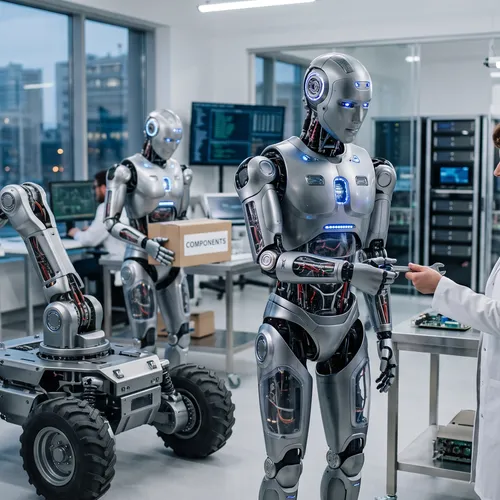

SFT 2026-27 - LLASO Project 4 - AI Predictive Maintenance for Lunar Robots
SFT 2026-27 - LLASO Project 4 - AI Predictive Maintenance for Lunar Robots
NASA Reference Name: LLASO-P4-AI-MAINT-2026
Executive Summary
Develop an AI system that reads robot telemetry, predicts failures before they happen, and dispatches at-risk robots to the P5 Repair Garage while rotating a standby unit into service — so the fleet keeps running even when no human technician is immediately available. Deliverable: an AI prototype running on simulated or real robot telemetry, with a dispatch interface that feeds the P5 repair workflow.
Requested By
NASA HUNCH / Kennedy Space Center; NASA AI / Autonomy Programs.
Problem Statement
Lunar robot fleets will operate for 30-60 day crewed missions and then autonomously for months between missions. Without predictive maintenance, undetected failures can ground robots at critical moments when no human technician is immediately available.
Requirements Overview
Collect motor, joint, wheel, battery, and thermal telemetry streams
Detect anomalies and predict failures with configurable thresholds
Generate a work order and route the robot to the P5 Repair Garage
Track a standby fleet and dispatch replacements automatically
Accept a robot self-diagnostic override (the robot can confirm or reject an AI flag)
Operate autonomously during uncrewed mission phases
Major Constraints
Real lunar robot telemetry may not be available — synthetic or scaled data must be used
Communication latency to Earth means the system must make decisions autonomously on-orbit
Multiple robot types (P2 transport, P3 unloading, mining, construction) have different failure modes; some robots are always inside and clean, others are always outside and dirty
Repair Garage (P5) capacity is limited — dispatch must prioritize by criticality
Key Challenges
Generating realistic failure signatures in training data without real hardware
Avoiding false positives that waste P5 garage capacity
Handling simultaneous multi-robot failure events gracefully
Balancing the predictive-maintenance schedule against active mission requirements
Cards
1 — Other Points / Comments
Start with robot telemetry 'logs,' which are more accessible and still highly relevant
Lunatics competition robots at KSC are a potential real-hardware data source (TBD)
Encourage teams to interview a NASA robotics project manager about real failure modes they have encountered
2 — Examples of Excellence
The system correctly predicts a motor failure 15+ minutes before a simulated breakdown using telemetry trend analysis
A live dashboard shows fleet status, the maintenance queue, and predicted time-to-failure per robot
The system manages standby rotation with zero mission gaps during a full simulated mission cycle
3 — Examples of Innovation
Federated learning: each robot contributes to a shared failure model without centralizing raw data
A natural-language interface: the crew asks 'which robots are at risk this week?' and gets a spoken summary
A failure root-cause explainer: the AI not only flags a failure but explains WHY in plain language for the technician
Suggestions for High School Students
Simulated telemetry from an RC robot or a stepper motor is an acceptable data source
The AI model can be a simple threshold / rule system for beginner teams; use machine learning for advanced teams
The dispatch interface can be a dashboard mockup rather than a live system
A single robot type (for example, the transport robot only) is fine for keeping the scope manageable
Please review more info below:
Requirements Spec
File Specification
Other Points / Comments
Examples of Excellence
Samples of Innovation
User Stories