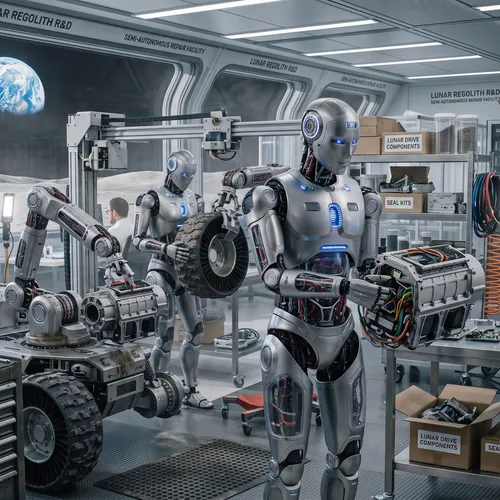
SFT 2026-27 - LLASO Project 5 - Semi-Autonomous - Lunar Robots Repair Garage (Shirt-Sleeve Maintenance Facility)
SFT 2026-27 LLASO Project 5 - Semi-Autonomous - Lunar Robots Repair Garage (Shirt-Sleeve Maintenance Facility)
NASA Reference Name: LLASO-P5-GARAGE-2026
Executive Summary
Design a pressurized 'shirt-sleeve' garage where humans and maintenance robots can service the lunar robot fleet without EVA suits. It accepts robots through a dust-exclusion airlock, provides service bays and parts storage, and receives work orders from the Project 4 AI system. It is the physical home that ties Projects 2, 3, and 4 together. Deliverable: a facility floor plan, an ingress/egress dust-control design, an operations workflow, and a physical or CAD mock-up of at least one service bay, plus robots that can actually do as many repairs as possible, starting with Parts or Subsystem SWAPS, if possible board SWAPS in a SUBSYSTEM, and the Board and Component Testing and Repair.
Requested By
NASA HUNCH / Kennedy Space Center; NASA Habitation / Robotics.
Problem Statement
The growing lunar robot fleet (transport, unloading, mining, construction) will require regular maintenance and repair. Doing this work in full EVA suits is slow, expensive, and risky. A pressurized shirt-sleeve facility is needed where both humans and maintenance robots can work efficiently. Note: some robots will remain inside buildings only, and others will be outside-only robots.
Requirements Overview
A pressurized shirt-sleeve interior (no EVA suit required for normal work)
A dust-exclusion airlock or wash-down zone for robots entering from regolith
A minimum of 2 service bays plus 1 standby parking area
Tool and parts storage integrated into the bay layout
A work-order interface that receives dispatch from the P4 AI system
A robot return-to-service certification process before redeployment
Redundant power and air supply (no single point of failure)
Major Constraints
Regolith is abrasive and electrically charged — it must be fully excluded before the pressurized area
A shirt-sleeve environment means all repair work happens without pressure suits — this is safety-critical
The facility must function during uncrewed mission phases (maintenance robots work autonomously)
Size and mass constraints: the garage must be modular and deliverable by existing or near-term launch vehicles
Key Challenges
Designing an airlock that can pass a large wheeled robot without letting regolith through
Determining the right balance of human vs. robotic technician tasks in the bay
Keeping the facility operational when humans are not present for months
Sourcing, storing, and tracking spare parts in a supply-constrained environment
Cards
1 — Other Points / Comments
This project ties together P2, P3, and P4 — the garage is the physical home for the AI dispatch system
Encourage teams to study ISS maintenance operations and terrestrial cleanroom designs for inspiration
The human/robot collaboration model inside the garage is a rich design space: who does what, and when?
Connect to Space Force engagement: military forward-operating-base maintenance facilities are a useful analog
2 — Examples of Excellence
A full dust-exclusion airlock is designed with a robot wash-down cycle and tested with a substitute granular material
The operations workflow covers the full loop: AI dispatch received, bay assigned, repair completed, robot tested, robot returned to fleet
The facility includes a standby robot parking and charging zone that feeds directly into the P4 standby rotation
3 — Examples of Innovation
A modular bay design: additional bays snap on as the robot fleet grows, scalable to a lunar campus
The robot self-checks in at a diagnostic station on entry and pre-stages its own repair work order
Waste material from repairs is sorted and routed to the LLASO recycling / reuse track (a future project)
Suggestions for High School Students
A scale model of the garage is acceptable instead of a full-size prototype
The dust-exclusion system may be simulated with a substitute material (for example, fine sand)
The operations workflow may be presented as a process diagram rather than a live system
Teams may focus on just one aspect: layout design OR dust exclusion OR the work-order system
Please review more info below:
Requirements Spec
File Formats
Other Points / Comments
Examples of Excellence
Samples of Innovation
User Stories