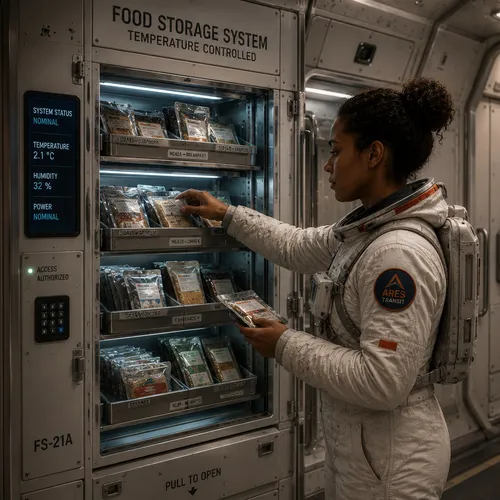

Transit Habitat Food Storage
Executive Summary
The Mars Transit Habitat Food Storage Design Challenge tasks students with designing and building a prototype cold storage module for NASA's planned crewed Mars missions under the Evolvable Mars Campaign. A round-trip Mars mission lasting 1,100–1,200 days presents an unprecedented food storage challenge: all food must be launched in advance with no resupply opportunity, a portion of the food supply requires refrigeration or freezing to maintain viability over the mission duration, and conventional powered refrigeration systems used on the ISS are too power-hungry and volume-intensive to scale to a deep space transit habitat. The proposed solution is a passively cooled food storage module that docks permanently to the exterior of the transit habitat and leverages the extreme cold of deep space to minimize power consumption. Students design a scaled prototype (no larger than 2 cubic feet) with separate compartments for food and biological samples, an inventory system, and flight-appropriate material recommendations. The challenge incorporates thermal engineering, microgravity heat transfer physics, space systems design, and food science.
Problem Statement
A crewed Mars transit mission lasting 8–9 months requires all food to be launched pre-packaged, with zero resupply capability en route. While most food will be dehydrated, freeze-dried, or vacuum-sealed for room-temperature storage, some thermostabilized meals require sustained refrigeration or freezing to remain safe and nutritious across the mission timeline. Current ISS refrigeration technology relies on powered systems with high energy demands and large facility footprints that do not scale to the constrained power and volume budget of a deep space transit habitat. At the same time, microgravity fundamentally changes how heat transfer works — natural convection is suppressed without gravity-driven buoyancy, making conventional cooling strategies ineffective or power-prohibitive. The cold of deep space is an untapped thermal resource that could passively maintain food at freezing temperatures, but no modular, low-power food storage solution currently exists that harnesses it while also accommodating dual-use storage for both crew food and biological samples at different temperature ranges. A purpose-built, passively cooled storage module is needed that can dock to the transit habitat, maintain adequate freezing temperatures with minimal power draw, compartmentalize food and biological samples, and survive the full mission duration without maintenance or resupply.
Students need to review the documentation and see other links for helpful resources for this project.